Handlebars and Heavy Things
A Financial Strategy Learned the Hard Way, at Low Speed.
The Sanctuary of Grease
On my sixth birthday, my dad took me downtown to Berg’s Bike Shop in Cleveland. This wasn’t some sanitized department store trip where a teenager in a vest pulls a box off a shelf. This was a real bike shop. It was a dark, narrow sanctuary that smelled of fresh rubber tires, heavy-duty chain grease, and the sort of serious, whispered decisions grown men make about velocity.
He bought me a chrome-framed Huffy banana bike with a red sparkly seat that I am fairly certain could be seen from low-earth orbit. It was glorious. It was excessive. It was completely impractical for a kid who spent most of his time in the dirt. It was, in a word, perfect.
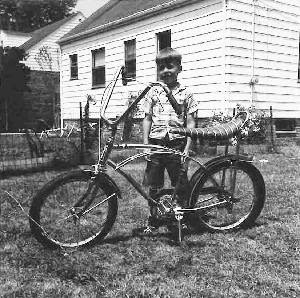
Me and the Huffy, circa 1968. I spent the first year just trying to find the pedals without a search party.
Tuesday vs. The Laws of Physics
By the time I was fourteen, that sparkly seat had to go to work. I delivered the afternoon Cleveland Press. My equipment consisted of that Huffy and a heavy canvas bag that had seen better decades. On a normal Tuesday, life was good. I’d sling the bag over the handlebars, stuff it with rolled newspapers, and ride through the neighborhood.
At the time, Alex Bevan was singing about a "Skinny Little Boy from Cleveland, Ohio"—a leather-jacketed demon who roared into town to drink all the beer and chase all the women. In my head, that was me. In reality, I was just a skinny kid with a back tire that didn't smoke so much as it squeaked.
Then came Wednesday. Wednesday was Sales Insert Day. On Wednesdays, the papers didn’t just double in size; they somehow violated the laws of physics and tripled in weight. I would load up the bag and suddenly the front end of the Huffy would drop like a lead weight. I’d cinch the heavy canvas strap around the handlebars, but the bag was so bloated it would rub against the front tire, acting like a primitive, unintended brake.
I’d start pedaling, and the entire operation became a test of faith and structural integrity. Every block was a slow-motion drama. If I turned the handlebars too sharply, the weight of the bag would try to take me to the pavement. I was wobbling down Lakeshore Boulevard, my knees pumping and my arms burning. I wasn't the demon Alex Bevan sang about; I was just a fourteen-year-old wrestling a chrome-plated bear. Somewhere between Vine Street and the edge of my sanity, I learned a vital lesson: Carrying too much weight gets old fast.
The Maple Tree Revelation
The solution to my weight problem arrived on the front page of the very paper that was currently trying to kill me. It was 1976. Congress had just passed the Individual Retirement Account. The IRA. I remember stopping under a massive maple tree to catch my breath. I leaned the Huffy against the trunk and stared at the headline. To my teenage brain, it might as well have said: THE HEAVY LIFTING IS OVER.
I didn't grasp the complexities of tax-deferred growth, but I understood the math. If you put a little bit away now, time would do the work later. It lodged in my brain right next to the realization that hauling unnecessary weight was always, blessedly, optional.
That same year, the Press ran a special full-color insert: the Farrah Fawcett pinup.
I made a strategic executive decision. I figured that most of my adult male customers didn't need the distraction. I liberated a fair number of those inserts before they could weigh down my handlebars. I regret nothing. I considered it a weight-reduction fee.
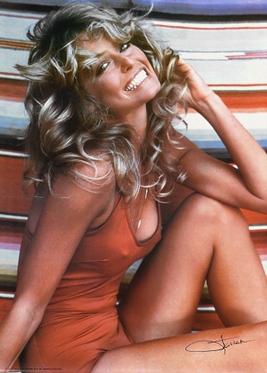
The infamous "Weight-Reduction Fee." I consider this a vital community service for the heart health of Cleveland.
The Lazy Route
As an adult, I spent years trying to be an investing genius. I read the magazines and watched the tickers. I briefly apprenticed with a financial group where the manager told me, “Leonard, your job is just to hook them. We’ll reel them in.” I turned in my binder the next day. It felt exactly like that Wednesday afternoon on Lakeshore Boulevard. Too heavy. Too complicated. Too many people trying to grab my handlebars so they could steer me toward their commission.
I decided to stop fighting the bike and discovered Index Funds. Think of an index fund like a giant basket that holds a tiny piece of every company in the market. Instead of trying to guess which single horse is going to win the race, you just own the whole track. It’s simple, it’s cheap, and it doesn't require a guy in a suit to explain it to you.
But the real magic happened when I found the "Lazy Portfolio" strategy—a concept coined by the folks over at the Bogleheads forum. The idea is to take a few of those broad index funds—maybe one for the US market, one for international, and one for bonds—and balance them out. It’s like distributing the newspapers evenly across the bike so you don't wobble into traffic when the market gets shaky. It doesn’t try to outrun the pack; it just rides with it. It was like finally choosing the lighter route home.
The Real Payoff
I recently read an article by a PhD fellow who wrote 2,000 words about the paradox of money. He argued that money and wealth aren't the same thing. I could have told him that forty years ago.
Money is just the bike. It’s the chrome, the chain grease, and the tires. You need it to be in good shape so you don't break down, but the bike isn't the point. Wealth is the ride. Wealth is the scenery you're actually able to enjoy because you aren't staring at your front tire praying you don't crash.
Wealth is the time to grade a half-acre lawn until it’s level as a pool table, the breath to tell a story, and the freedom to ignore the "shoulds" in the brochures so you can follow your own heart. Money keeps you upright; wealth is where you go once you're moving.
The Light Route Home
Decades have passed, and that skinny kid is now dealing with required minimum distributions instead of sales inserts. The math has changed, but the principle is identical. Don’t carry more than you have to. Don’t let other people pile their baggage onto your handlebars.
Turns out the best strategy wasn’t beating the market or finding the perfect route. It was learning early that if you don’t want to spend your whole life hauling things, you’d better figure out what’s worth carrying, and what’s worth leaving on the curb.
I am not an expert. I am a generalist. I notice things.